Beyond cryptographic discovery: Mapping supplier dependencies, upgrade control, and business-critical exposure.
By Xhield Research | SkureCloud Infosec

The Hidden Challenge in Post-Quantum Readiness
The transition to post-quantum cryptography (PQC) is often presented as a technical challenge: identify vulnerable cryptographic algorithms, replace them with quantum-resistant alternatives, and validate that systems continue to operate securely.
But for large enterprises, particularly financial institutions, the challenge is considerably more complex.
What happens when an organization knows exactly which cryptographic components need upgrading, but does not control when those upgrades can happen?
Imagine five critical banking services relying on a single third-party digital signing platform. Each service has a documented cryptographic dependency. Each has a migration plan.
Yet the signing platform's supplier has not released a compatible PQC implementation.
All five services are now constrained by a dependency they cannot independently remediate.
This is not merely a cryptographic vulnerability management problem. It is a dependency ownership and migration coordination problem.
And it could become one of the defining challenges of enterprise post-quantum readiness.
1. Why Cryptographic Discovery Is Only the Beginning
Most organizations already maintain some form of asset inventory, software bill of materials (SBOM), or dependency management system.
However, these inventories do not necessarily answer the questions that matter most for PQC migration:
- Which applications depend on quantum-vulnerable public-key algorithms?
- Which cryptographic libraries, certificates, signing services, and protocols are involved?
- Are these components internally maintained or controlled by external suppliers?
- Who has the authority and technical ability to upgrade them?
- Which critical business services depend on the successful migration of these components?
A Cryptographic Bill of Materials (CBOM) can help document cryptographic assets and dependencies.
But a CBOM alone does not automatically establish upgrade ownership, supplier commitments, migration feasibility, or business impact.
Cryptographic visibility tells us what exists. Contextual dependency intelligence tells us what must change, who can change it, and what happens if the change is delayed.
2. The Supplier-Controlled Migration Bottleneck
Consider an illustrative financial services environment.
Five business-critical applications depend on one external signing service.
That service uses a cryptographic mechanism requiring migration for long-term quantum resilience.
Illustrative dependency structure
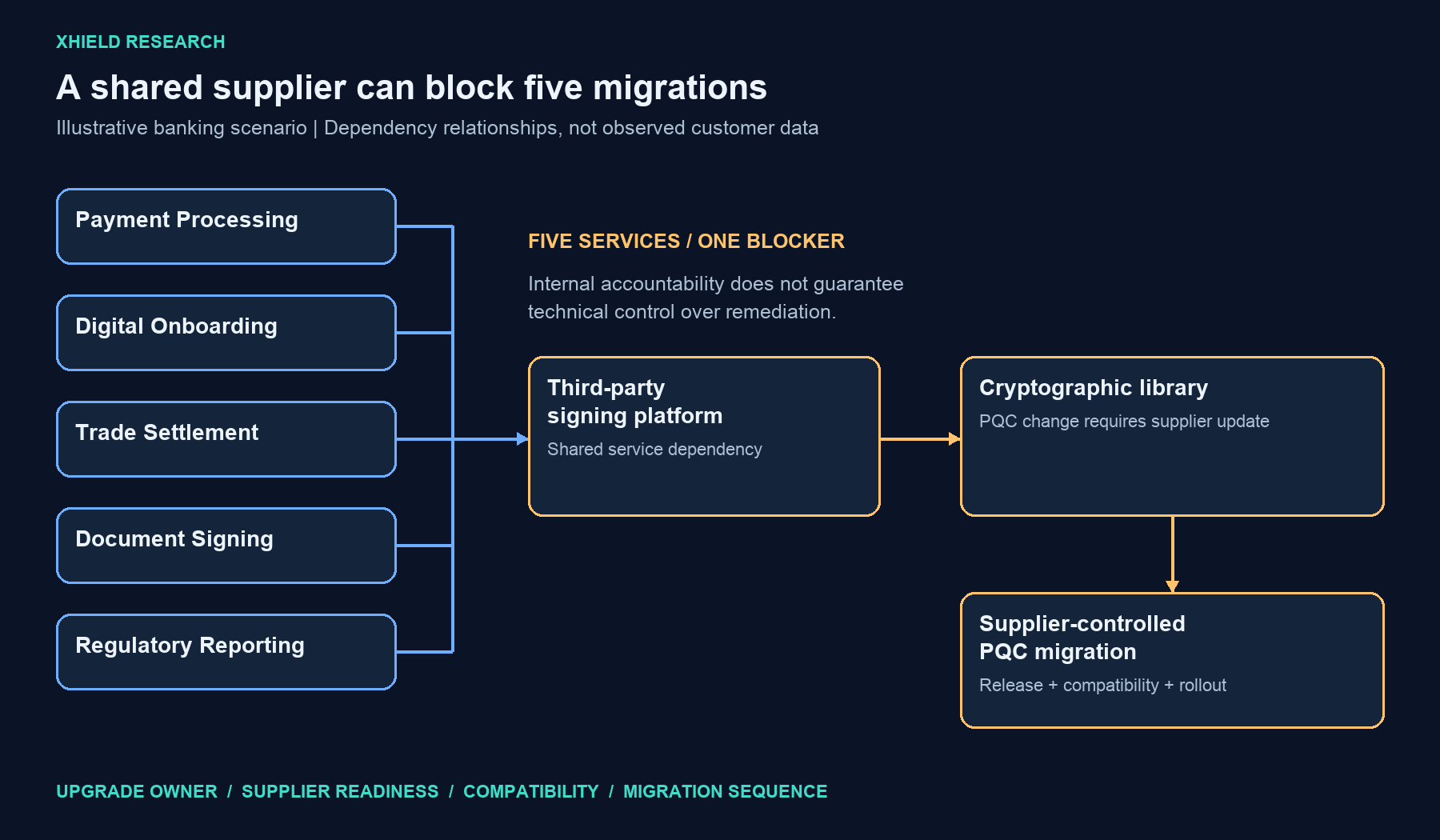
Even if the bank has completed its internal cryptographic inventory, the migration schedule may remain dependent on the supplier's roadmap.
This creates several risks.
Concentration risk: Multiple critical services rely on one cryptographic dependency.
Migration ownership risk: The organization consuming the service may lack authority to modify its underlying cryptographic implementation.
Schedule dependency risk: A supplier delay can affect several enterprise migration milestones simultaneously.
Compatibility risk: Upgrading a shared cryptographic service may require coordinated changes across clients, protocols, certificates, hardware security modules, and verification systems.
Residual exposure risk: Critical services may continue relying on quantum-vulnerable cryptography while migration dependencies remain unresolved.
The lesson is straightforward:
A shared cryptographic dependency can become a shared migration bottleneck.
3. Why Traditional Vulnerability Prioritization Is Insufficient
Traditional vulnerability management commonly prioritizes findings using factors such as severity, exploitability, asset criticality, and exposure.
PQC migration introduces additional considerations.
A cryptographic dependency may have no known practical exploit using today's computing capabilities, yet still require urgent attention because it protects sensitive information with a long confidentiality lifetime.
This is particularly relevant to harvest-now, decrypt-later threats, where adversaries may collect encrypted information today with the intention of decrypting it if sufficiently capable quantum computers become available.
Migration prioritization must therefore consider more than algorithm identification.
It should account for:
- Data confidentiality lifetime and sensitivity.
- Cryptographic function, including encryption, key establishment, authentication, and digital signatures.
- Business criticality of dependent systems.
- Dependency concentration and potential failure impact.
- Supplier migration readiness.
- Technical compatibility and upgrade ownership.
- Availability of alternative providers or architectures.
A service protecting long-lived confidential information may deserve earlier attention than another service with a shorter data sensitivity window, even when both use similar cryptographic mechanisms.
This requires contextual risk prioritization, not simply a count of cryptographic findings.
4. From CBOM to a Cryptographic Dependency Intelligence Graph
A promising architectural approach is to extend cryptographic inventory into a relationship-aware dependency graph.
Instead of treating cryptographic assets as isolated records, organizations can connect them to the systems, suppliers, business services, and migration responsibilities surrounding them.
A conceptual graph might include:
Business Service → Application → Cryptographic Component → Algorithm → Supplier → Upgrade Owner → Migration Readiness
Additional relationships could capture:
- Which applications consume a shared cryptographic service.
- Which certificates and protocols rely on particular algorithms.
- Which suppliers provide or maintain those components.
- Who owns migration decisions and implementation.
- Which upgrades depend on external releases or certifications.
- Which critical services remain exposed until migration is complete.
This model could support questions that conventional inventories struggle to answer.
For example:
Which critical services are blocked by a supplier that has not committed to a PQC migration timeline?
Which shared cryptographic components create the greatest concentration of migration risk?
What is the business impact if a supplier's upgrade is delayed by twelve months?
Which systems could migrate independently, and which require coordinated ecosystem changes?
The goal is not simply to produce a more detailed inventory.
It is to turn cryptographic dependency data into actionable migration intelligence.
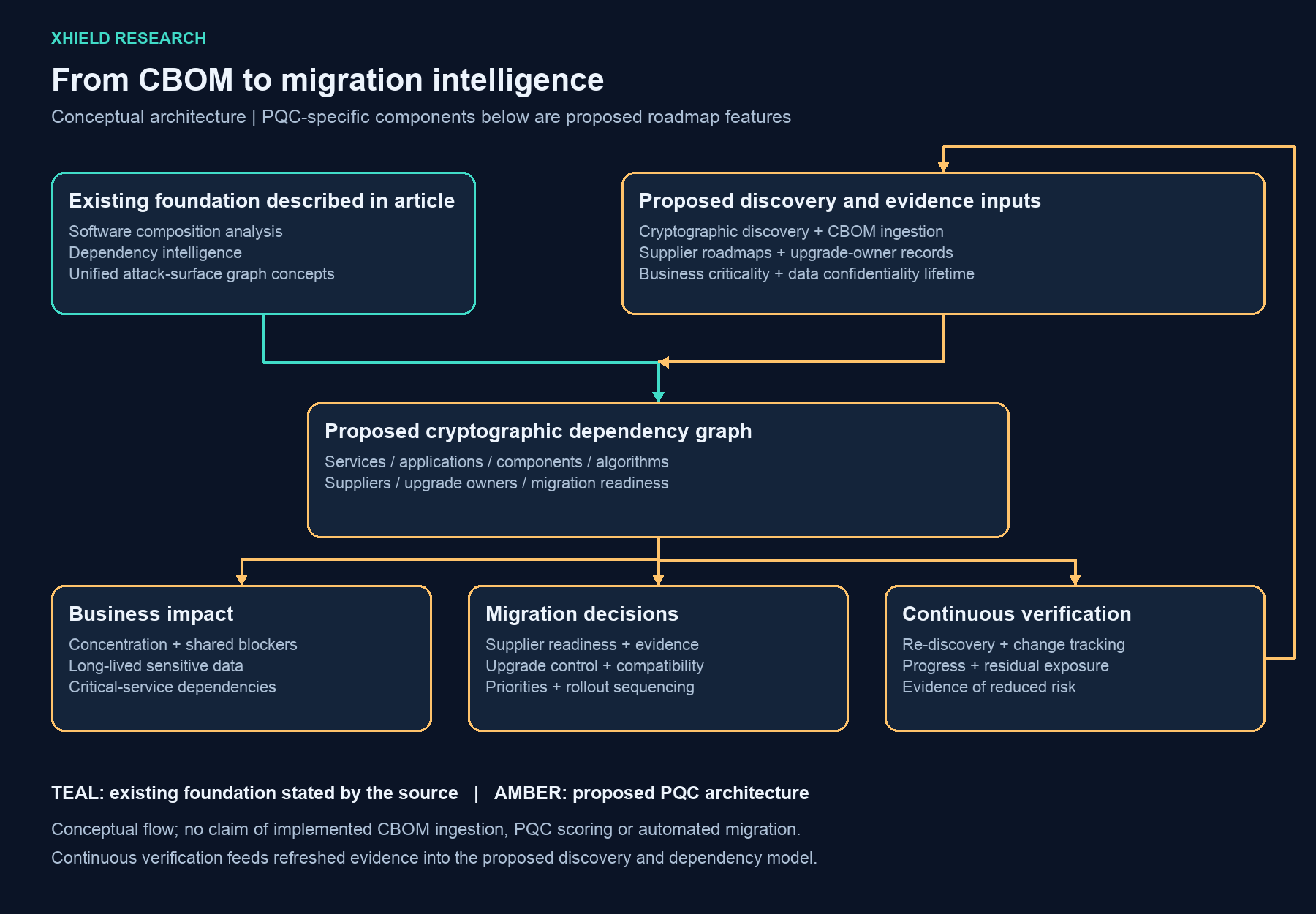
Architecture illustration: PQC-specific discovery, CBOM analysis, supplier readiness, migration prioritization and verification are proposed capabilities. The existing foundation is limited to the SCA, dependency intelligence and graph concepts described in this article.
5. Migration Ownership Is a Security Attribute
In conventional asset management, ownership often means identifying the person or team responsible for an asset.
For PQC migration, ownership needs a more precise definition.
An organization may own an application but not control its cryptographic implementation.
It may operate a service but depend on a supplier for protocol support.
It may control the encryption keys but still require third-party software updates to support new algorithms.
Therefore, several distinct ownership attributes become relevant:
| Ownership dimension | Key question |
|---|---|
| Asset owner | Who is accountable for the affected system? |
| Technical owner | Who maintains the cryptographic component? |
| Upgrade controller | Who can implement or authorize the change? |
| Supplier dependency | Which external organization must deliver an update? |
| Migration coordinator | Who manages compatibility and rollout? |
| Risk owner | Who accepts or escalates residual business risk? |
These relationships matter because accountability for a risk does not always imply technical control over its remediation.
Recognizing that distinction early can prevent unrealistic migration plans.
6. Supplier Readiness Should Become Measurable
Organizations should consider assessing supplier PQC readiness through evidence-based criteria rather than relying solely on general statements of intent.
Relevant evidence may include:
- A documented inventory of affected cryptographic products and services.
- A published or contractually communicated migration roadmap.
- Support for relevant standardized post-quantum algorithms.
- Compatibility testing and interoperability plans.
- Evidence of crypto-agility and configurable cryptographic implementations.
- Defined migration dependencies, limitations, and customer responsibilities.
- Clear procedures for communicating delays and changes.
Such assessments can help distinguish between suppliers that have identified the problem, suppliers actively preparing solutions, and suppliers that have demonstrated working migration capabilities.
Importantly, these should not be treated as universal compliance requirements without reference to the applicable regulatory and contractual context.
7. The Role of Continuous Attack Surface Intelligence
Cryptographic environments are not static.
Applications are updated. Dependencies change. Certificates rotate. Cloud services evolve. New suppliers are introduced.
A cryptographic inventory created today may become incomplete as the enterprise changes.
This suggests a role for continuous discovery and contextual analysis throughout the migration lifecycle.
A future-oriented security intelligence architecture could combine:
Cryptographic discovery → Dependency mapping → Supplier ownership → Business impact analysis → Migration prioritization → Continuous verification
Such an approach could help security teams identify newly introduced quantum-vulnerable dependencies, monitor migration blockers, and assess whether completed upgrades have actually reduced the intended exposure.
For Xhield, this represents a potential research and product direction building on software composition analysis, dependency intelligence, and unified attack-surface graph concepts.
Cryptographic discovery, CBOM analysis, supplier migration intelligence, and PQC readiness scoring should be understood as potential future capabilities rather than existing product functionality.
8. What CISOs and Technology Leaders Should Ask Today
Organizations do not need to predict the exact arrival date of a cryptographically relevant quantum computer to begin preparing.
They can start with practical questions.
- Do we know where quantum-vulnerable public-key cryptography is used across critical systems?
- Which cryptographic dependencies are shared across multiple business services?
- Which components can we upgrade independently, and which are supplier-controlled?
- Have our critical suppliers provided credible migration roadmaps and supporting evidence?
- Which sensitive datasets require protection beyond the expected migration horizon?
- Can we identify business services whose migration is blocked by a single external dependency?
- How will we continuously verify migration progress and residual exposure?
The answers can form the foundation of a realistic, risk-based PQC transition program.
9. The Next Frontier: From Cryptographic Inventory to Migration Intelligence
The post-quantum transition is not merely an algorithm replacement exercise.
It is a coordinated transformation involving software architectures, suppliers, trust relationships, cryptographic protocols, business processes, and operational resilience.
Cryptographic discovery provides the starting point.
Dependency mapping reveals interconnected exposure.
Supplier intelligence establishes who controls remediation.
Business context determines which migration blockers matter most.
Continuous validation helps demonstrate whether the migration is progressing as intended.
The next generation of cryptographic risk intelligence should answer three questions:
What is exposed? Who controls the upgrade? What remains at risk until the migration is complete?
Because ultimately, knowing what depends on what is only half the challenge.
Knowing who can change it—and when—may determine how quickly an organization becomes quantum-ready.
Xhield Research explores emerging approaches to continuous attack surface intelligence, software dependency security, graph-based contextual risk analysis, and proactive cyber resilience.
Learn more: https://xhield.tech
Suggested references
- NIST — FIPS 203, 204, and 205: Post-Quantum Cryptography Standards.
- NIST — IR 8547: Transition to Post-Quantum Cryptography Standards.
- CISA, NSA, and NIST — Quantum-Readiness: Migration to Post-Quantum Cryptography.
- CycloneDX — Cryptographic Bill of Materials (CBOM) specification.
- IOSCO — Implications of Quantum Computing on Financial Markets (19 November 2026; publication details to be verified before citation).
Product capability clarification
Editorial packaging note; supplements the original article.
| Status | Scope |
|---|---|
| Existing foundation described in the supplied article | Software composition analysis, dependency intelligence, and unified attack-surface graph concepts. This is a description from the article, not a new independent product validation. |
| Proposed research / roadmap | Cryptographic discovery, CBOM ingestion and analysis, cryptographic dependency graph extensions, supplier migration intelligence, upgrade-ownership mapping, PQC readiness scoring, migration prioritization and continuous PQC verification. No delivery date is asserted. |
The supplier diagram is an illustrative scenario. The architecture diagram is a conceptual design, not a representation of deployed PQC product functionality. The IOSCO reference remains explicitly unverified, as stated in the supplied article.