TL;DR
Pre-VAPT helps you understand what to test, why it matters, and where you're exposed before you start a VAPT engagement, so you spend less time on noise and more on real risk.
Introduction
Security teams often treat VAPT (Vulnerability Assessment & Penetration Testing) as the starting point of security.
In reality, VAPT is often the last step — and by the time it begins, critical security blind spots are already baked into the system.
This gap is exactly where Pre-VAPT comes in.
Pre-VAPT is not a replacement for VAPT.
It is a preparatory security intelligence phase that helps organizations understand their true attack surface before expensive and time-bound testing begins.
What Is Pre-VAPT?
Pre-VAPT is the practice of discovering, correlating, and prioritizing security exposure before formal VAPT execution.
It focuses on answering foundational questions such as:
- What exactly should be tested?
- Which assets are actually exposed?
- Where does risk originate — code, dependencies, configs, or cloud?
- What changed since the last VAPT?
Instead of starting with scanning tools or pentests, Pre-VAPT starts with visibility and context.
Core Elements of Pre-VAPT
- Attack surface discovery (code → dependencies → infra → cloud)
- Dependency and supply-chain risk mapping
- Configuration and exposure awareness
- Change detection since last assessment
- Risk prioritization before testing
Why Traditional VAPT Fails Early
Traditional VAPT is extremely valuable — but it fails before it even begins due to structural limitations.
1. Unknown or Incomplete Scope
Most VAPT engagements rely on:
- Manually prepared asset lists
- Outdated architecture diagrams
- Incomplete cloud inventories
You only test what you know — not what actually exists.
Hidden microservices, abandoned APIs, unused subdomains, or transitive dependencies are often never tested.
2. Time-Boxed Testing Misses Deep Risks
VAPT is usually constrained by:
- Fixed timelines
- Fixed budgets
- Fixed scope
As a result:
- Complex dependency chains are ignored
- Misconfigurations are deprioritized
- Low-visibility attack paths are skipped
Critical risks don’t disappear — they’re just postponed.
3. Too Many Findings, Too Little Context
VAPT reports often contain:
- Hundreds of vulnerabilities
- Little correlation to business risk
- No mapping to actual exploit paths
Security teams struggle to answer:
- Which findings matter now?
- Which risks block production?
- Which vulnerabilities are already exploitable?
4. Reactive Instead of Preventive
Traditional VAPT is:
- Periodic (quarterly / yearly)
- Snapshot-based
- Backward-looking
By the time VAPT starts:
- New code is already deployed
- New dependencies are already introduced
- Cloud configurations have already changed
How Pre-VAPT Fixes These Problems
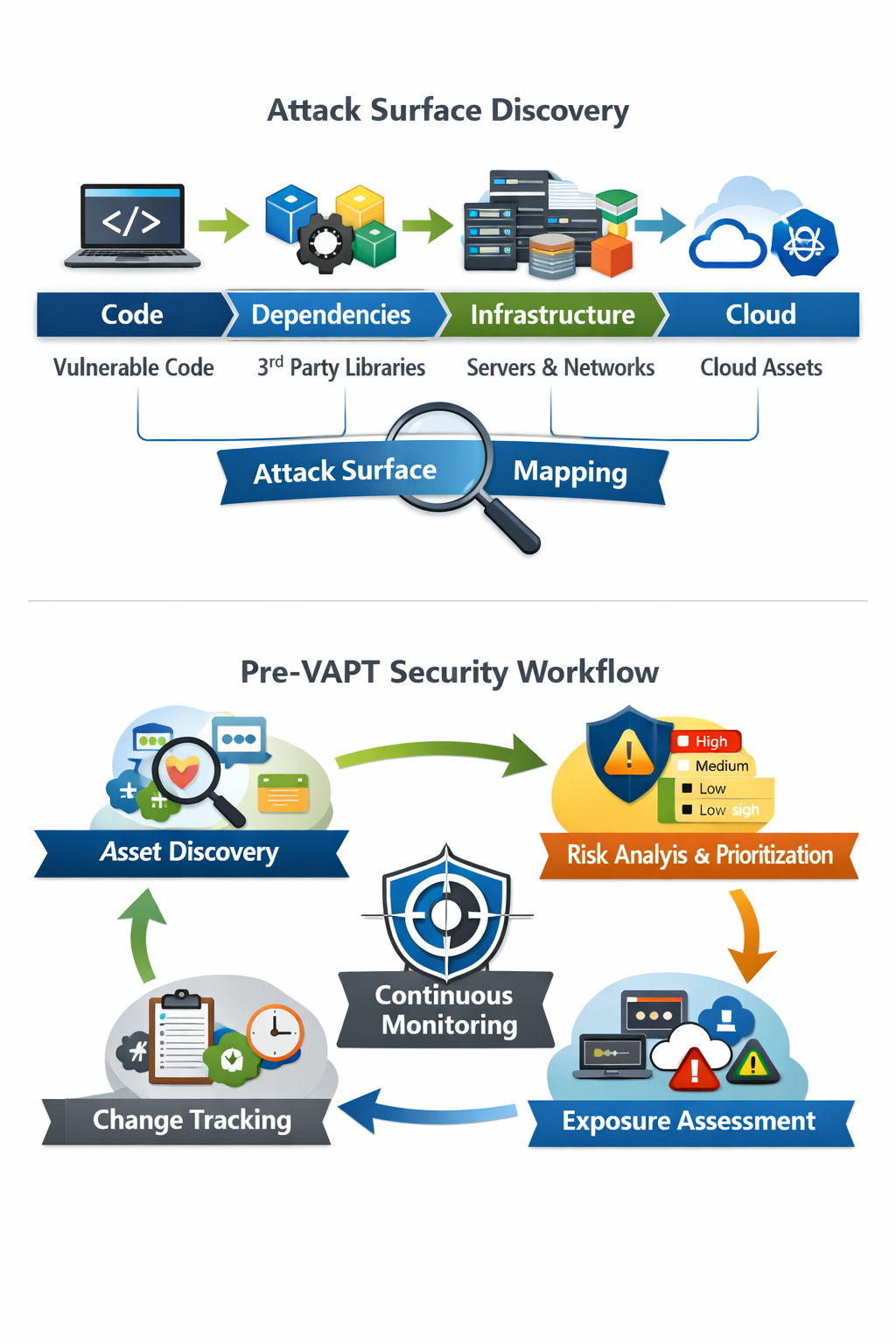 Attack surface discovery and the Pre‑VAPT security workflow from discovery to continuous monitoring.
1. Accurate, Living Scope Definition
Pre-VAPT automatically discovers:
- Applications and services
- Open ports, APIs, endpoints
- Dependencies and transitive dependencies
- Cloud resources and configurations
VAPT starts with facts, not assumptions.
2. Risk-Driven Testing
Instead of testing everything equally, Pre-VAPT helps:
- Rank assets by exposure
- Identify high-risk components early
- Focus pentesting where it matters most
This leads to:
- Better coverage
- Fewer blind spots
- Lower testing cost
3. Cleaner, Actionable VAPT Reports
When VAPT is informed by Pre-VAPT:
- Findings are contextualized
- Duplicate noise is reduced
- Remediation becomes clearer
Security teams get:
- Fewer findings
- Higher signal-to-noise ratio
- Faster remediation cycles
4. Continuous Readiness, Not One-Time Testing
Pre-VAPT is:
- Continuous
- Change-aware
- Automation-friendly
It allows teams to:
- Detect risk before audits
- Prepare continuously for VAPT
- Reduce last-minute security fire drills
Pre-VAPT vs Traditional VAPT
| Aspect | Traditional VAPT | Pre-VAPT |
|---|---|---|
| Timing | After build/deploy | Before VAPT |
| Scope | Static & manual | Dynamic & discovered |
| Frequency | Periodic | Continuous |
| Focus | Vulnerabilities | Exposure & risk |
| Outcome | Long reports | Prioritized intelligence |
Who Should Care About Pre-VAPT?
Pre-VAPT is especially useful for:
- Product and engineering teams shipping frequently
- Security teams overwhelmed with large VAPT reports
- Cloud-native organizations with many microservices and APIs
- Regulated industries (fintech, healthtech, SaaS) that must prove security posture continuously
If you recognize these patterns in your organization, introducing Pre-VAPT can quickly improve the signal-to-noise ratio of every future VAPT engagement.
Real-World Example
A fintech organization runs annual VAPT.
Without Pre-VAPT:
- 30% of exposed services were out of scope
- Dependency risks were missed
- Cloud misconfigurations were found late
With Pre-VAPT:
- Attack surface was reduced before testing
- VAPT scope was precise
- Findings dropped by 40%
- Fix time reduced significantly
Is Pre-VAPT Replacing VAPT?
No. And it shouldn’t.
Pre-VAPT:
- Makes VAPT more effective
- Makes pentesters more productive
- Makes security teams more confident
Think of it as:
Security intelligence before security testing.
Final Thoughts
Traditional VAPT answers:
“What vulnerabilities exist right now?”
Pre-VAPT answers:
“What should we test, why, and where are we exposed?”
Organizations that adopt Pre-VAPT:
- Spend less on reactive fixes
- Get more value from VAPT
- Reduce unknown risk
How to Get Started with Pre-VAPT
You don’t need a full program redesign to start benefiting from Pre-VAPT. Begin with:
- Inventory what you already expose – apps, APIs, subdomains, cloud accounts.
- Map dependencies and configurations – especially third-party services and cloud defaults.
- Prioritize by business impact and exposure – decide what must be in scope for the next VAPT.
- Feed this context into your VAPT partner or internal red team – so testing effort aligns with real risk.
Even a lightweight Pre-VAPT pass before your next VAPT cycle can make the results dramatically more focused and actionable.
About Xhield
Xhield enables Pre-VAPT by discovering attack surfaces across code, dependencies, infrastructure, and cloud — before formal testing begins.
If VAPT tells you what broke,
Pre-VAPT tells you what will break next.